

Longer-lasting fluffy towels – understanding care symbols correctly


Are your towels no longer drying properly or feeling as soft as they did at first? This is often not due to their quality, but to incorrect care. In this article, we explain what the care instructions on bathroom textiles mean, so that towels, bathrobes and bath sheets stay beautiful for longer.
Wash before first use
Before using them for the first time, towels and similar items should be washed in the washing machine. This cycle removes any possible dust from production and storage. In the case of terry towelling, washing also tightens the loops. This helps prevent pulled threads from forming. If a loose thread does appear later on, it can simply be cut off with a sharp pair of scissors. Because of the risk of pulled threads, terry towelling should ideally not be washed together with clothing that has hooks or zips.
Apart from this precaution, terry textiles are easy to care for and uncomplicated. There is therefore no need to worry too much about making mistakes when washing this type of fabric, provided the manufacturer’s instructions on the care label are followed.
This is what the care symbols mean
The care symbols on the labels provide important information about cleaning and caring for the fabric. To help textiles retain their function for as long as possible, these recommendations should be followed carefully.
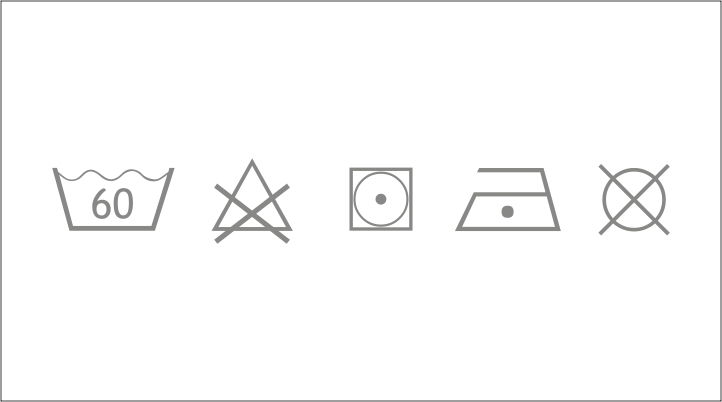
The small tub symbol represents a washing tub. If the symbol is crossed out, the item must not be washed in the washing machine. However, this is generally not the case for towels, flannels or bathrobes.
A hand in the tub symbol means hand wash. Many washing machines now offer a suitable delicates programme for this. Hand wash means a maximum water temperature of 40 °C. The number inside the tub indicates the maximum water temperature at which the material may be washed.
The symbol may also be supplemented with lines underneath. One or two underlines indicate particularly gentle washing. This restriction does not usually apply to terry items such as towels, bath sheets or bathrobes.
The instructions for drying laundry are symbolised by a square. The circle inside the square stands for the tumble dryer. If the symbol is crossed out, the item must not be tumble-dried under any circumstances. Without any additional marks, the symbol means that the textile may be dried using the normal programme. Express drying should be avoided.
Dots may also appear here. One dot means gentle drying at a low temperature. If the tumble dryer does not have a delicates programme, the manual will usually explain how to reduce the temperature. Two dots indicate a drying programme at a high temperature. In that case, quick and express programmes will not harm the laundry.
The iron symbol summarises all information relating to ironing the laundry. Here too, the rule applies: if the symbol is crossed out, the item must not be ironed. Suitable temperatures are again indicated by dots. On many appliances, these can be found on the temperature selector. One dot stands for a low temperature, two dots for a medium temperature and three dots for a high temperature.
If the washing machine reaches its limits with stubborn stains, the care label will also indicate whether the item may be dry-cleaned. The relevant symbol is a circle. The letters inside are only relevant for professional dry-cleaning staff. If the circle is crossed out, the fibres must not be dry-cleaned. This applies, for example, to most terry products.
Fabric conditioner for towels?
Unfortunately, fabric conditioner coats cotton fibres like a film. This reduces their absorbency. For this reason, it is advisable to avoid using fabric conditioner on terry towelling as far as possible.
Can terry towelling go in the tumble dryer?
If terry towelling is dried directly in the air or even on a radiator, the fibres unfortunately become stiff. Drying on a radiator in particular is therefore not recommended. The best results are achieved in a tumble dryer. This keeps the fibres soft and helps preserve that fluffy feel for a long time.